Kudzu
(Japanese Arrowroot)
Brilliant sparkle revealing from vines
Light, bright and delicate fiber
Scientific Classification
Fabaceae
Pueraria
Examples of Names in Japanese
Kudzu, Kan ne kadzura
I can't describe my amazement in words - the brilliant sparkle revealed from rotten vine covered with fluffy mycelium! What a elegance had been concealed in it, although it is a very common creeping weed and sometimes disliked for it covers ground and buildings very quickly.
On a hot and humid summer day, in a cool fresh stream up in a hill, I watched the unveiled silky fibers swaying and shimmering in clear water; I wanted to watch it forever.
A black butterfly came fluttering down to the rotten vines being laid at the streamside - It might know the beautiful brightness hiding there.


[Memo]
*Numbers in the text are reference numbers
Charasteristics of Kudzu plant
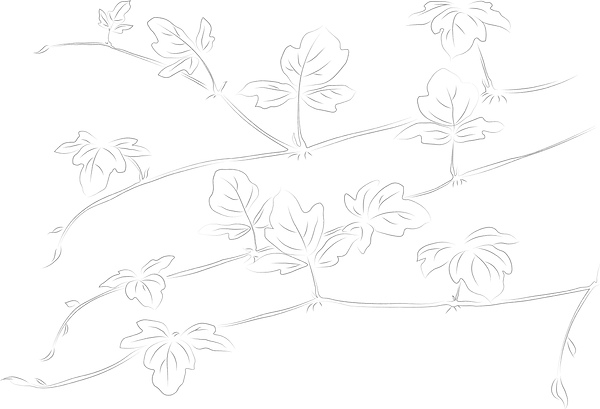
Kudzu, or Japanese arrowroot is creeping perennial plant, very common in Japan. 3 leaves come out together from one shoot. Small, violet flowers come out around end of summer. It grows rapidly and abundantly, spreading runners.
It is - or at least used to be - a useful material in our daily life; leaves used to be animal feed.*1 Flowers are an ingredient of herbal tea. Roots are the material of popular Chinese medicine for cold, sweets or drink. And vines are used for making baskets and fiber products.

Properties of Kudzu Fiber
Its feature is the brilliant luster. In order to preserve the brightness, the hand-jointed yarn, which is flat, is sometimes not twisted and directly woven into fabrics.*2
Kudzu fiber ribbon is very light and thin like polyethylene film and can be split very smoothly; it might come from the fineness of fiber cells. According to a report, they are much thinner than ramie fiber cells and also have holes at the center like ramie(12).
It breaks relatively easily with tension; I guess it's because I extracted it by retting. The fabric made of Kudzu is light and crisp, feel warm to touch a little.
【Related Articles】
まだ記事がありません

タイトルタイトルタイトルタイトル
テキストです。ここをクリックして「テキストを編集」を選択して編集してください。
見出し h4
*1 I heard in Showa village in Fukushima that people used to set an opening date of gathering Kudzu. They called the day "Kuzo no yama no kuchi": "Kuzo" is a dialect of "Kudzu" and "Yama no kuchi" literally means "opening day of mountains". Kuzdu was once so useful and necessary in daily life that they set a rule not to over-collect the natural resource, while we now even pay for removing it.
Note: they set opening dates for also other plant materials such as silver grass. It means they used to supply themselves what they need in their lives gathering wild plants around them.
*2 Untwisted yarn is flat and shiny, but weaker than twisted one. Since Kudzu fiber which are extracted by retting is relatively weak against tension, untwisted yarn seems to be used only as weft; as I mentioned in other pages, warp must be durable. If twisted, it can be used also as warp, but in Japan, I heard it can be found mostly in old examples; cotton or silk warp is now often woven with kudzu weft.
【References】
-
柳田國男『木綿以前の事』
-
ルイズ・アリソン・コート「日本の古代織物3種の移り変わる運命」『布と人間』アネット・B・ワイナー 他 編, 佐野 敏行 訳, 1995年,ドメス出版
-
布目順郎『目で見る繊維の考古学』1992年, 染織と生活社
-
長野五郎、ひろいのぶこ『織物の原風景 樹皮と草皮の布と機』1999年, 紫紅社
-
『太宰府町の文化財 第1集 -菖蒲浦古墳群の調査-』1976年, 太宰府町教育委員会
-
『葛布と日本の自然布』2019年, 全国古代織連絡会
-
小林孝子「日本在来織布の研究(第一報)」 『家政学雑誌』 26巻1号 p50-56, 1975 年, 一般社団法人 日本家政学会
-
小林孝子「日本在来織布の研究-葛布について-」『鹿児島大学教育学部研究紀要 自然科学編』第25巻p75-81, 1974年, 鹿児島大学
-
深津裕子「伝統工芸技術の記録と保存-江戸時代後期の 「葛布道中着」に用いられた素材の復元を事例として-」『無形文化遺産研究報告』第4号 p61-74, 2009年, 独立行政法人国立文化財機構東京文化財研究所
-
深津裕子「染織工芸技術の変遷-葛布の製作技法と用途を事例として-」『無形文化遺産研究報告』第2号 p35-53, 2008年, 独立行政法人国立文化財機構東京文化財研究所
-
岩崎 史子 「現代における葛布の可能性」2009年. 滋賀県立大学人間文化学部道明研究室